
Table of Contents
Most AI strategies stall not because the model is weak, but because it can't do anything.
Look at the top panel of this chart.
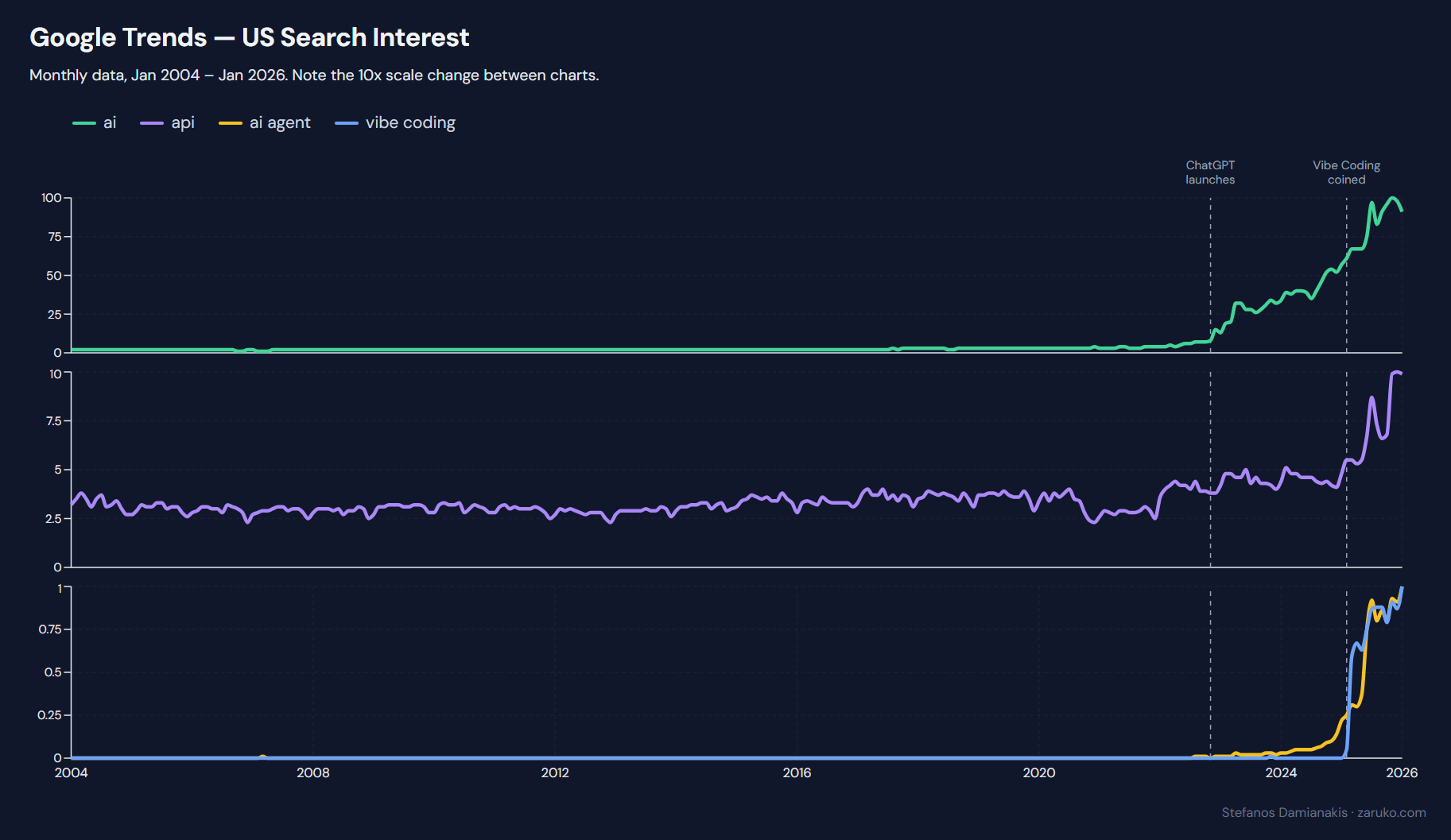
Google Trends, US search interest, Jan 2004 – Jan 2026. Note the 10x scale change between panels.
"AI" dominates. After ChatGPT launched in late 2022, it went from background noise to peak search interest. At this scale, everything else is invisible. You'd never know the other three terms existed.
Now look at the middle panel. Zoom in 10x. There's "API," holding steady between 3 and 4 for twenty years. Not trending. Not declining. Just there, quietly ticking along as more and more of the world's software connected through APIs. Then around early 2025, it spikes to its highest point ever.
Now the bottom panel. Zoom in another 10x. "AI agents" and "vibe coding" (a term coined by Andrej Karpathy1) emerge from nothing and go vertical, at the exact same moment APIs spiked.
Three different scales. One inflection point. That's not a coincidence.
What happened? People went from talking about AI to building with AI. And the moment they started building, they discovered that AI needs APIs to do anything real.
Everyone Talks About Data. Nobody Talks About APIs.
When people discuss AI, they talk about models. They talk about training data. They talk about prompts and fine-tuning and hallucinations.
What they rarely talk about is how AI actually does anything useful.
An AI model can reason through a problem. It can write code. It can analyze documents. But by itself, it can't send an email, process a payment, check your inventory, or update your CRM.
For that, it needs APIs.
A Brief History
APIs have been around for decades, but the modern web API era started in 2000. Salesforce launched its API on February 7, 2000, at the IDG Demo conference.2 Nine months later, eBay launched the eBay Application Program Interface along with the eBay Developers Program.3 Amazon followed in July 2002 with Amazon Web Services, allowing developers to incorporate Amazon's content and features into their own websites.4
These early APIs were about data sharing and integration. But they planted a seed.
By 2005, eBay's API was generating 20% of the company's listings.5 Twitter launched its API in 2006, and within a year there were dozens of third-party clients and tools built on top of it.6
Then came the monetization wave. Companies like Twilio and Stripe realized that APIs could be products in their own right. They built businesses by solving common problems that every developer faced.
Before Stripe, if you wanted to accept payments, you had to integrate directly with payment processors, manage PCI compliance, and handle a mountain of complexity. After Stripe, you could add payments to your app with a few lines of code.
Before Twilio, if you wanted to send text messages or make phone calls programmatically, you needed to negotiate contracts with carriers and build infrastructure. After Twilio, it was an API call.
This shift from APIs as internal plumbing to APIs as monetized services changed everything. Today, Twilio generates over $1.3 billion in quarterly revenue with more than 390,000 active customers.7 The API management market alone has grown to nearly $7 billion.8
APIs didn't just integrate software. They standardized action.
Why This Matters for AI
But all that AI capability means nothing without a way to take action.
An AI agent can figure out that you need to schedule a meeting with three colleagues. But unless it can access your calendar API, check their availability, and send calendar invites, it's just telling you what to do. You're still doing the work.
An AI agent can analyze your expenses and identify anomalies. But unless it can pull data from your accounting API and flag items in your expense management system, it's just a report. You're still doing the work.
This isn't theoretical. One team built an AI assistant that could analyze invoices, flag anomalies, and recommend approvals. Impressive demo. But it couldn't actually approve anything, because their ERP had no API for it. Six months of development, and someone still had to click the button.
The reason the "API" search trend spiked alongside "vibe coding" is that people are discovering this reality. AI coding tools can write code quickly. But that code needs to call APIs to do anything meaningful. Suddenly, understanding what APIs exist and how to use them matters a lot more.
The Real AI Stack
When you hear about AI transforming business, the stack looks something like this:
- The model (GPT, Claude, Gemini, etc.) provides reasoning capability
- Your data provides context and information specific to your business
- APIs provide the ability to take action
Most of the conversation focuses on #1 and #2. But #3 is what turns an AI from a research assistant into something that actually does work.
APIs are how AI agents take action. They're what let the reasoning capability translate into real-world work.
What This Means for Your Business
If you're thinking about AI adoption, don't just think about models and data. Think about what actions you want AI to take, and whether you have the API infrastructure to enable those actions.
Questions to consider:
- What systems does your business run on, and do they have APIs?
- Are those APIs documented and accessible?
- Do you have the technical capability to integrate AI with those APIs?
- What actions would create the most value if automated?
The businesses that will get the most out of AI won't necessarily be the ones with the best data. They'll be the ones whose systems can talk to each other.
APIs quietly powered the last twenty years of software. Now they're powering the AI revolution. If your AI strategy doesn't include an API strategy, you don't have an AI strategy.
Footnotes
- Andrej Karpathy on X, February 2, 2025. "There's a new kind of coding I call 'vibe coding', where you fully give in to the vibes, embrace exponentials, and forget that the code even exists." x.com ↑
- Postman Blog, "Intro to APIs: History of APIs." Salesforce officially launched its API on February 7, 2000 at the IDG Demo conference. blog.postman.com ↑
- Postman Blog, "Intro to APIs: History of APIs." On November 20, 2000, eBay launched the eBay Application Program Interface (API) along with the eBay Developers Program. blog.postman.com ↑
- Postman Blog, "Intro to APIs: History of APIs." On July 16, 2002, Amazon launched Amazon.com Web Services. blog.postman.com ↑
- Qodex.ai, "The Complete History of the Invention of API." By 2005, eBay's API was already generating 20% of the company's listings. qodex.ai ↑
- Qodex.ai, "The Complete History of the Invention of API." In 2006, Twitter launched its API, which led to a proliferation of third-party Twitter clients and tools. qodex.ai ↑
- Twilio Q3 2025 Earnings Release. Twilio's Q3 2025 revenue of USD 1.3 billion and an active customer base exceeding 392,000. investors.twilio.com ↑
- Fortune Business Insights, "API Management Market Size, Trends | Global Report [2032]." The API management market is projected at $6.89 billion in 2025. fortunebusinessinsights.com ↑
Frequently Asked Questions
Why are APIs important for AI?
APIs are the action layer that allows AI to do useful work. AI models provide reasoning and data provides context, but without APIs, AI can only generate text. APIs let AI agents send emails, update CRM records, process payments, and interact with business systems. If your AI strategy does not include an API strategy, your AI can think but it cannot act.
What is an AI API strategy?
An AI API strategy means ensuring your business systems expose well-documented, secure APIs that AI agents can use to take actions. This includes mapping which systems need API access, defining what actions AI should perform, setting rate limits and permissions, and ensuring proper authentication. The companies getting real value from AI are the ones that built this integration layer.
Continue Reading
First Principles of AI
Ten foundational principles for evaluating AI claims and making better decisions.
The Simple Rule that Separates AI Winners from Everyone Else
Automate the repeatable. Keep humans on the judgment calls.
The Software Feature No One Asked For
AI agents break traditional permission models. Here's what companies need.
Building an AI strategy that actually works?
I help mid-market companies move from AI demos to real implementation. APIs, integrations, and measurable results. Let's talk about what it takes.
Let's Talk