AI Agents Automate the Grunt Work. Your Team Focuses on Judgment.

President, Zaruko
Table of Contents
Part 2 of 2: Building VerifyFilings, an AI Agent for Financial Statement Analysis
In Part 1, I walked through the inside of an AI agent, the engineering required to make it a real product, and the decisions that make one trustworthy. Now I want to step back from the technical details and talk about what this means for your business.
Here's the operational punchline: one person built a working AI agent that pulls data from government databases, runs hundreds of statistical checks, and produces a professional analytical report, in days, using commercially available tools.
Not a team. Not a multi-year project. Not millions in funding. One person with domain expertise, off-the-shelf APIs, a language model, and a small amount of glue code.
That should change how you think about automation in your organization. If one person can build this in days, what could a focused team inside your company do in a month?
The Pattern That Repeats Everywhere
VerifyFilings follows a specific workflow pattern: gather data from authoritative sources, apply domain-specific checks and rules, synthesize the findings, and deliver a report. I call this the gather-check-synthesize-deliver pattern.
In one sentence: it's the same shape as most compliance and finance work. Pull inputs, run tests, write a narrative, ship a deliverable.
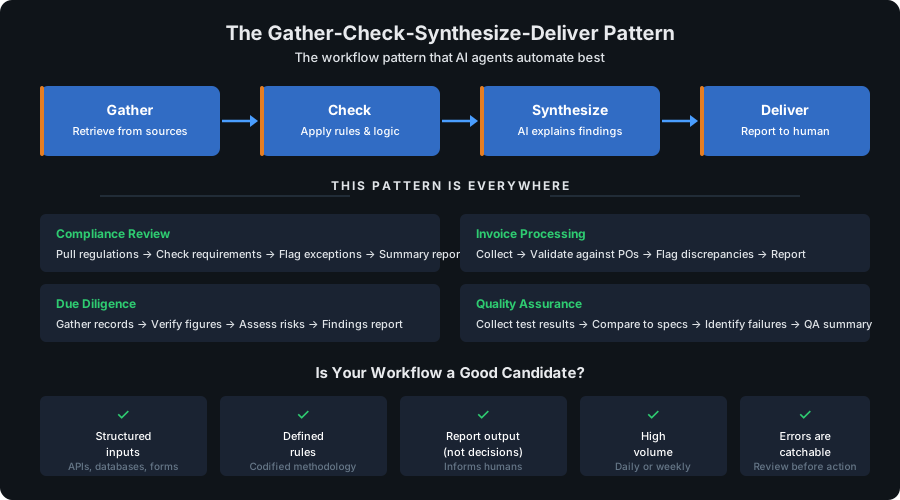
The gather-check-synthesize-deliver pattern. If your workflow ends in a narrative report, an agent can usually do the first pass.
Now think about your own business. How many workflows follow that same shape?
A compliance team pulls regulatory filings, checks them against current requirements, flags exceptions, and writes a summary. An accounts payable department collects invoices, validates them against purchase orders and contracts, identifies discrepancies, and reports exceptions. A due diligence team gathers financial records, verifies key figures, assesses risk factors, and produces a findings report. A quality assurance process collects test results, compares them against specifications, identifies failures, and generates a summary.
These workflows exist in every mid-market company I've worked with. They consume significant human hours. And they follow the exact same pattern that VerifyFilings automates.
To make this concrete: imagine your compliance team spends 20 hours a week reviewing filings and writing summaries. An agent handles the gathering and first-pass analysis. You don't reduce headcount. You redeploy those hours into higher-level risk assessment that never got the attention it deserved. That's not a technology story. That's an operating leverage story.
What's Changed and What Hasn't
Automation isn't new. Businesses have been automating repetitive tasks for decades. What's changed is that AI can now assist at every stage (collection, analysis, and synthesis), which means workflows that took days can run in minutes.
Traditional automation handled the structured parts: rule-based validation, exception flagging, moving data between systems. But it couldn't handle unstructured or semi-structured inputs, couldn't adapt when formats changed, and couldn't read a complex set of results and write a coherent narrative that a human decision-maker can act on.
Large language models changed that equation across the board. Not perfectly and not without oversight, but well enough that the human role shifts from "do the work" to "review the work." That's a meaningful change in how work gets distributed.
Agents are fast, not magic. Your advantage is the rules you encode, the data quality you maintain, and the review loop you enforce.
How to Identify Where Agents Can Help
Not every workflow is a good candidate for an AI agent. Based on what I've built and what I've seen working with clients, here are the five characteristics that make a workflow a strong fit:
1. The inputs are structured or can be structured. If the data comes from databases, APIs, standardized documents, or defined formats, an agent can retrieve and process it reliably. If the inputs are ad hoc, ambiguous, or require extensive human judgment just to collect, the automation gets much harder.
2. The analysis follows defined rules. If your team applies a known set of checks, criteria, or standards, those rules can be encoded in software. The more codified the methodology, the better the fit.
3. The output is a report or summary, not a decision. AI agents excel at producing deliverables that inform human decisions. They're poorly suited to making consequential decisions autonomously. If the workflow ends with "here's what we found, you decide what to do," that's a strong candidate. If it ends with "approve this loan" or "fire this employee," keep a human in the loop.
4. The volume justifies the investment. Building an AI agent isn't free. If a workflow runs once a quarter, the math probably doesn't work. If it runs daily or weekly across dozens of instances, the return adds up quickly.
5. Errors are detectable and recoverable. The best candidates are workflows where a wrong answer gets caught before it causes damage. Financial reconciliation is a good example: if the agent flags something incorrectly, a reviewer catches it. Medical diagnosis is a bad example: the cost of a wrong answer is too high and detection comes too late.
What This Means for Your Team
I want to be direct about something: AI agents will change job descriptions, but the change is more nuanced than the "AI will replace everyone" narrative suggests.
Some roles will compress. A task that took a team of three will take one person with an agent. Some roles will become supervisory, shifting from producing analysis to reviewing it. And some job descriptions will shrink where the work is mostly retrieval and reformatting. That's worth acknowledging honestly.
But the most common outcome I've seen is that agents handle the gathering and preliminary analysis, and humans shift to review, interpretation, and decision-making. The work becomes more interesting. A financial analyst who spends three days pulling data and running checks can instead spend that time thinking about what the data means and what to do about it.
The people who will thrive are the ones who understand their domain deeply enough to know when the agent's output is right and when something needs a closer look. Domain expertise becomes more valuable, not less, when you have an AI agent doing the preliminary work.
Start Small, Learn Fast
If you're thinking about where AI agents could fit in your organization, my advice is to start with a single workflow that fits the criteria above. Pick one that's high-volume, rule-based, and produces a report rather than making a decision. I outlined a practical framework for this in Before You Bet 90 Days on AI.
Build a proof of concept or work with someone who can. Not to replace the team doing the work today, but to demonstrate what's possible and to learn where the friction points are. Every organization has its own data quirks, compliance requirements, and edge cases. The only way to understand how agents interact with those realities is to try one.
The technology is accessible. The tools are commercially available. The cost of experimentation has dropped dramatically. The gap isn't technology anymore. It's knowing which workflows to target and how to design the automation safely.
See It in Action
Try it yourself: verifyfilings.com. Enter any U.S. public company ticker. This is an early alpha release, and I'm actively improving it. Feedback and suggestions welcome.
The barrier to building these systems is no longer capital. It's clarity: knowing which workflows to target and how to design them safely.
Frequently Asked Questions
What is the gather-check-synthesize-deliver pattern for AI agents?
It's a four-step workflow pattern common to most compliance, finance, and analytical work: gather data from authoritative sources (databases, APIs, standardized documents), apply domain-specific checks and rules to validate it, synthesize findings into a coherent narrative, and deliver a professional report. If your workflow ends in a narrative report, an AI agent can usually handle the first pass.
Which business workflows are best suited for AI agents?
The strongest candidates have five characteristics: structured or structurable inputs, analysis that follows defined rules, outputs that inform decisions rather than make them, sufficient volume to justify the investment, and errors that are detectable and recoverable before causing damage. Common examples include compliance reviews, accounts payable validation, due diligence, and quality assurance reporting.
Will AI agents replace human workers?
The most common outcome is that agents handle gathering and preliminary analysis while humans shift to review, interpretation, and decision-making. Some roles will compress and some job descriptions will shrink where the work is mostly retrieval and reformatting. But domain expertise becomes more valuable, not less, when an AI agent does the preliminary work. The people who thrive are those who know when the agent's output is right and when something needs a closer look.
Continue Reading
Which AI Future Do You Believe In? The Terminator, Wall-E, or Star Wars
BLS, OECD, and 224 years of automation history all point to the same answer: AI changes tasks, not occupations.
What's Actually Inside an AI Agent (And Why Most of It Isn't AI)
Most of an AI agent isn't AI. I built one to prove it. Here's the actual breakdown.
The Simple Rule that Separates AI Winners from Everyone Else
Automate the repeatable. Keep humans on the judgment calls.
Ready to identify where AI agents fit in your business?
I help mid-market companies find the workflows where AI agents create real operating leverage, and build them safely. Let's talk.
Let's Talk