What 130 Real Agentic AI Vendors Reveal About Where the Technology Actually Works

President, Zaruko
Table of Contents
I recently wrote about the AI agent washing problem. Of the thousands of vendors claiming "agentic AI," Gartner says only about 130 are real.1
Most people stopped there. Interesting stat, move on.
But the 130 that aren't faking it tell a more useful story. If we study the vendors that actually work, what patterns emerge? And what do those patterns tell a business leader about where to place bets?
I spent time digging into the data. The answers are more revealing than the headline.
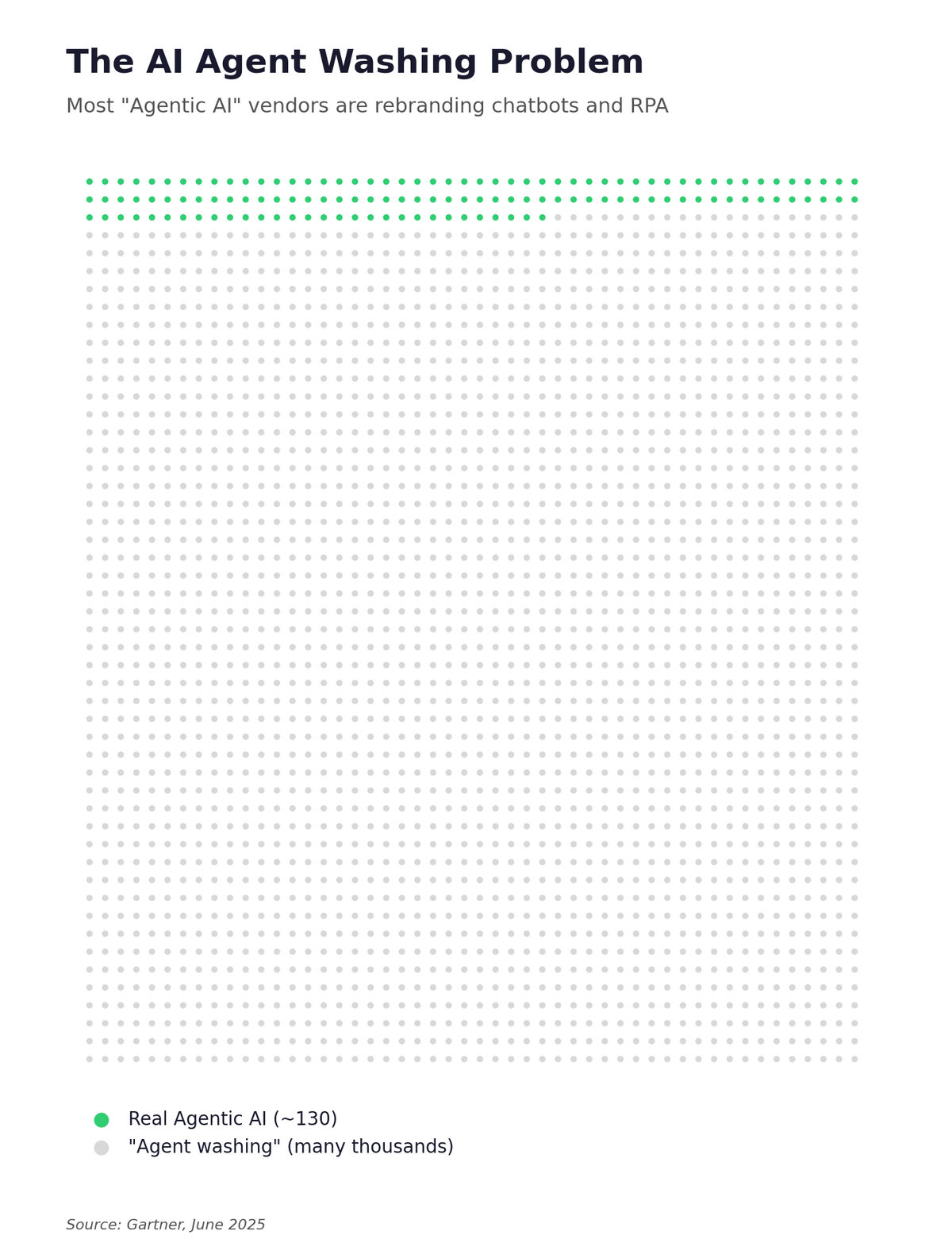
Only about 130 of thousands of agentic AI vendors are real (Gartner, June 2025)
They cluster in five domains
The 130 real agentic AI vendors are not spread evenly across the economy. Cross-referencing Gartner's findings with CB Insights' market mapping and industry deployment data, the real vendors concentrate in five domains where the problems are specific and the outcomes are measurable.235
IT operations and site reliability. This is the most mature domain for agentic AI. Agents monitor systems, detect anomalies, and resolve incidents autonomously. The results are concrete: 30-50% reduction in mean time to resolution, SLA compliance jumping from 85% to 95%+.4 Gartner predicts that by 2028, 40% of large enterprises will use agentic AI in IT infrastructure and operations, up from less than 5% in early 2025.
Cybersecurity. Autonomous threat detection and response. Agents analyze patterns across network traffic, endpoints, and logs faster than human analysts. The domain works because threats follow patterns, detection has clear success criteria, and speed matters more than nuance.
Software engineering. This is where the money is flowing fastest. Cursor and Replit are hitting $100M+ ARR. Agents handle code generation, testing, documentation, and deployment. The feedback loop is immediate: the code either passes tests or it doesn't.
Customer support. Agents resolve routine inquiries, route complex cases, and reduce cost per interaction by up to 60%. The key: support workflows are structured, outcomes are measurable (resolution time, customer satisfaction), and the cost of a wrong answer on a routine question is low.
Finance operations. Invoice processing, reconciliation, fraud detection, compliance checks. These are high-volume, rule-heavy processes with clear accuracy requirements. Agents handle the repetitive work while humans manage exceptions.
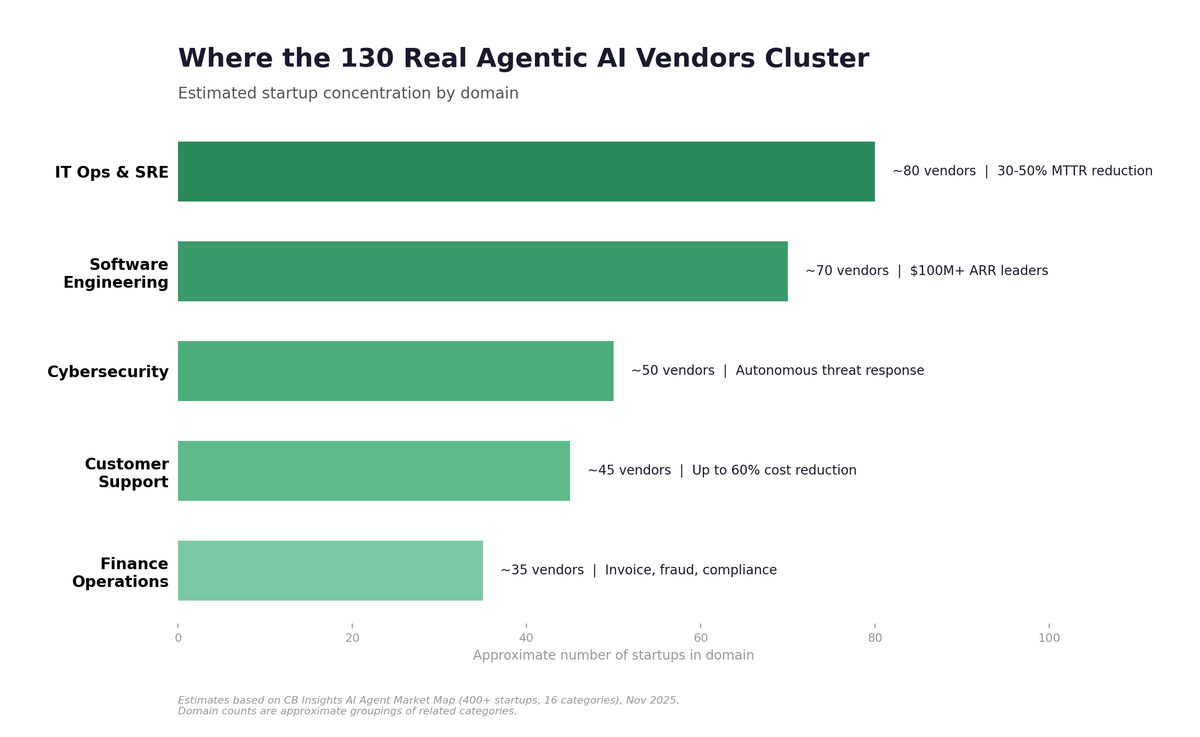
Estimated startup concentration by domain (CB Insights, November 2025)
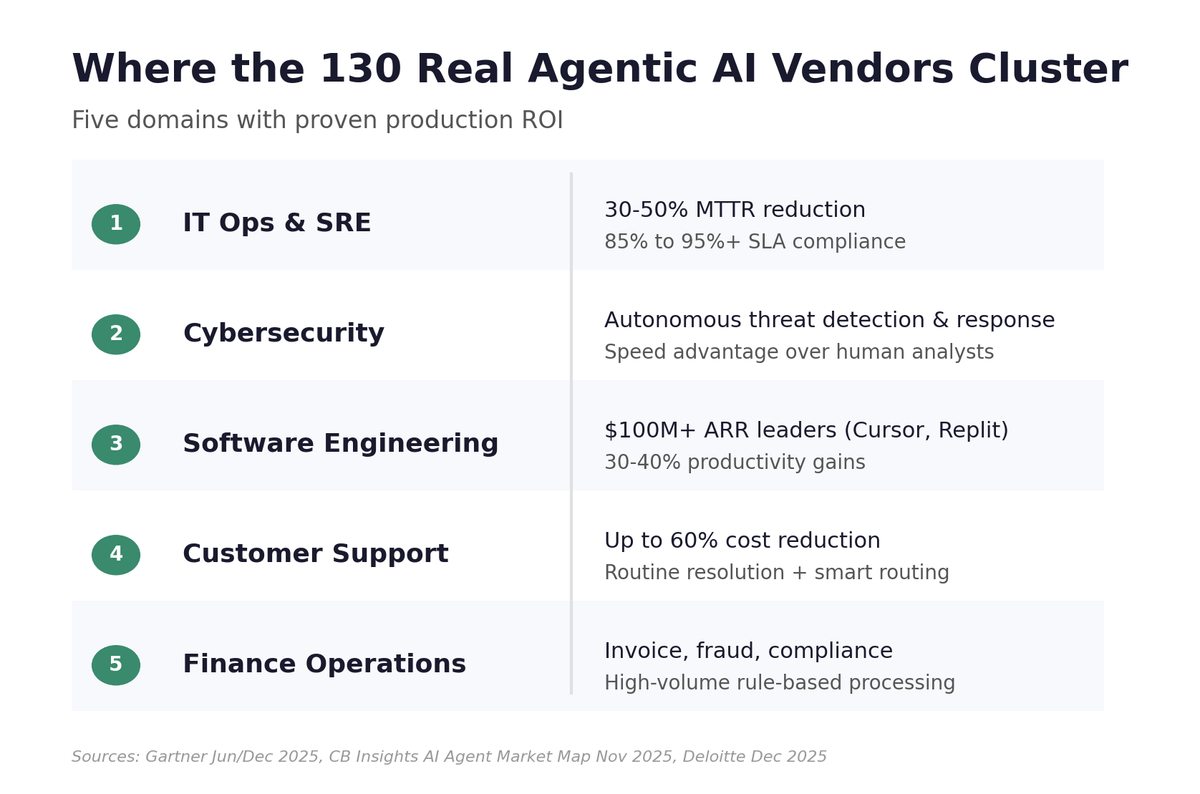
Five domains with proven production ROI
The pattern is unmistakable
Look at those five domains. They share specific characteristics that explain why agents succeed there and fail elsewhere.
Clear boundaries. Each domain has well-defined inputs, outputs, and success criteria. An IT ops agent knows what "resolved" looks like. A coding agent can run tests. A fraud detection agent has clear rules. There is no ambiguity about whether the job was done.
Measurable outcomes. Every successful domain has hard numbers attached: resolution time, ticket volume, cost per interaction, accuracy rate, revenue impact. You can calculate ROI within weeks, not years.
Structured workflows. The work follows repeatable patterns. Not identical every time (that would just need traditional automation), but similar enough that an agent can learn the playbook and handle variations.
High cost of human time, low cost of mistakes. In IT ops, having a human monitor dashboards 24/7 is expensive. An agent that catches 95% of issues and escalates the rest is far more efficient. In customer support, resolving routine questions with an agent frees human agents for complex cases. The key: when an agent makes a mistake in these domains, the consequences are manageable.
Fast feedback loops. The agent gets quick signals about whether it succeeded. A code test passes or fails. A support ticket is resolved or escalated. A threat is contained or it isn't. This is how agents learn and improve.
Now think about where agents fail: open-ended strategy work, complex negotiations, creative decisions, novel situations with no precedent. These lack every characteristic on the list above.
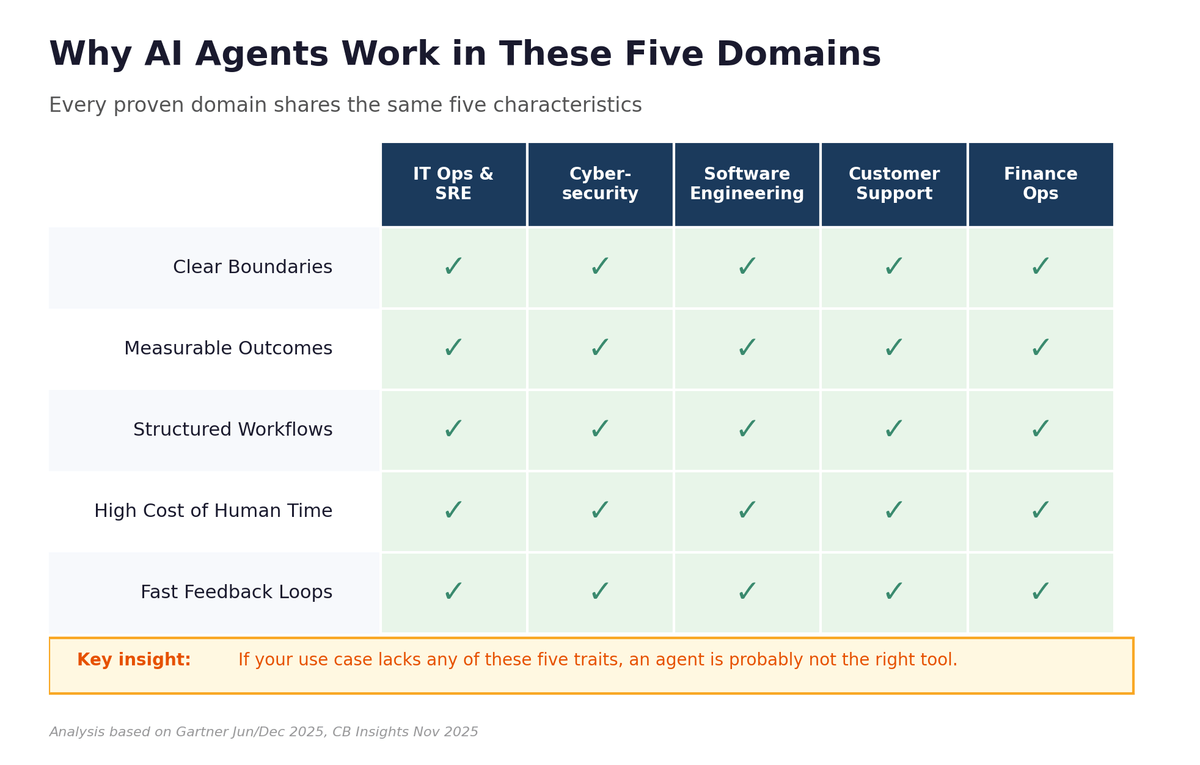
Every proven domain shares the same five characteristics
The "do everything" vendors are the fakers
Here is the sharpest insight from studying the 130. The real vendors are narrow. They solve one domain deeply. They know the workflows, the data structures, the edge cases, and the failure modes of their specific space.
The agent washing vendors are the opposite. They claim to do everything. "Agentic AI for the entire enterprise." "Autonomous agents for any workflow." These broad, horizontal claims are the single biggest red flag.
Gartner made this point explicitly. Google is the "Company to Beat" in enterprise agentic AI platforms because of its model infrastructure. But Gartner also noted that Google "hasn't taken major steps to build expert agents capable of solving specialized business problems."3 The opportunity is in specialization, not generalization.
This maps to a rule that has been true in enterprise software for decades: horizontal platforms enable, vertical solutions deliver. The real 130 are mostly vertical.
They are young and growing fast
The CB Insights data adds another dimension. The top 20 AI agent companies by revenue average just 3.8 years old.5 Over half of the companies in the agentic AI market were founded since 2023. This is not a mature market being disrupted. It is a new market being created.
What this means: the vendors that will dominate in two years may not be the names you recognize today. The incumbents (Microsoft, Google, Salesforce) are building platforms. The specialized agents delivering real ROI are mostly startups.
For business leaders, this creates both opportunity and risk. The opportunity: you can adopt proven agentic solutions in the five domains above with real ROI data. The risk: vendor stability. A 2-year-old startup with great technology may not be around in five years.
Multi-agent is the architecture that works
One more pattern: 66.4% of the real market focuses on coordinated multi-agent systems rather than single-agent solutions.5 The winning architecture is not one agent doing everything. It is multiple specialized agents collaborating, each handling a specific part of the workflow.
This mirrors how effective human teams work. You do not hire one person to do sales, support, and engineering. You hire specialists and coordinate them. The same principle applies to agents.
What this means for your business
If you are evaluating agentic AI, the 130 give you a practical framework.
Match the domain. Does your use case fall in one of the five proven domains? If yes, there are vendors with production data to evaluate. If no, proceed with extreme caution.
Check for specialization. The real vendors know their domain cold.
Ask for production metrics, not demo results. Resolution time, cost savings, accuracy rates, revenue impact. From real customers, in production, for at least 90 days.
Check the workflow fit. Does the use case have clear boundaries, measurable outcomes, and structured workflows? If not, an agent probably is not the right tool.
Look for the feedback loop. How does the agent know it succeeded? If there is no automated way to measure outcomes, the agent can not improve, and you can not measure ROI.
Start narrow. Pick one workflow in one domain. The companies getting results started small and expanded after proving value. The companies getting burned tried to automate everything at once.
These five domains are the starting point, not the ceiling
It is worth stating clearly: these five domains represent where agentic AI works today. The list will grow. As models get more capable, as tooling matures, and as companies build the governance frameworks to manage autonomous systems, agents will expand into new territory.
But the expansion will follow the same pattern. The next domains to tip will be the ones that develop clear boundaries, measurable outcomes, and fast feedback loops. Healthcare claims processing, supply chain optimization, legal document review, and regulatory compliance are all candidates. They share the structural characteristics of the current five.
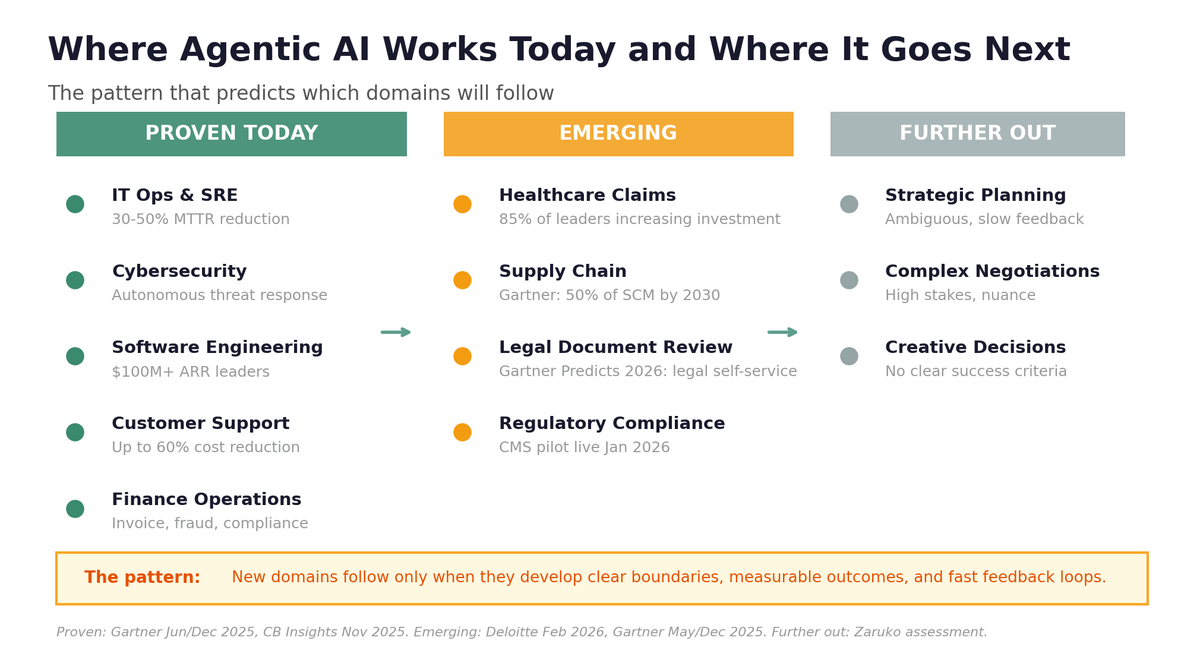
The pattern that predicts which domains will follow
The domains that will take longest are the ones with ambiguity, high stakes for individual errors, and slow feedback. Strategic planning, complex negotiations, creative work. These are not impossible for agents. They are just further down the road.
For business leaders, the practical implication is simple: start where the pattern is proven. Build the organizational muscle (governance, measurement, workflow documentation) in one of the five domains. That muscle transfers when the next domains open up.
The bottom line
The 130 real agentic AI vendors are a map. They show you exactly where this technology works today: constrained domains with clear boundaries, measurable outcomes, structured workflows, and fast feedback loops.
They also show you where it does not work: broad, open-ended, ambiguous problems that lack structure and measurement.
The hype says agents will transform everything. The data says they are transforming five specific types of work, and doing it well. That is not a disappointment. That is a starting point.
The smart money follows the pattern, not the hype.
Sources
- Gartner, "Gartner Predicts Over 40% of Agentic AI Projects Will Be Canceled by End of 2027," press release, June 25, 2025. gartner.com ↑
- ByteIota analysis of Gartner data, "Gartner: 40% Agentic AI Projects Fail," January 2026. Includes domain-specific ROI data and deployment case studies. byteiota.com ↑
- Gartner, "Gartner Identifies the Companies to Beat in the AI Vendor Race," press release, December 17, 2025. gartner.com ↑ ↑
- Gartner, "Predicts 2026: AI Agents Will Transform IT Infrastructure and Operations," December 4, 2025. gartner.com ↑
- CB Insights, "The AI Agent Market Map," November 2025. Mapped 400+ AI agent startups across 16 categories. cbinsights.com ↑ ↑ ↑
Frequently Asked Questions
How many real agentic AI vendors exist?
According to Gartner, roughly 130 out of thousands of vendors claiming agentic AI capabilities actually deliver them. The rest use 'agentic' as a marketing label for basic chatbots or simple automation. The 130 real vendors cluster in specific domains: customer service, software development, security operations, and back-office automation: areas with high-volume, repeatable tasks and clear success metrics.
Where does agentic AI actually work today?
Based on analysis of the roughly 130 real agentic AI vendors identified by Gartner, the technology works best in customer service (automated resolution of common tickets), software development (code generation and testing), security operations (threat detection and response), and back-office automation (invoice processing, data entry, compliance checks). These share common traits: high volume, clear rules, measurable outcomes, and low cost of errors.
Continue Reading
The AI Agents Hype Machine: What the Evidence Actually Says
AI agents are not running 13-company businesses with zero employees. A walk through what the evidence actually says about agent reliability in 2026.
Demystifying Agentic AI
What agentic AI actually is, what it isn't, and why most projects fail.
AI Agents Are Bringing Back Point Solutions
AI agents are reversing the logic that drove platform consolidation. Here's why point solutions are back.
Wondering where agentic AI fits in your business?
I help mid-market companies identify the right AI use cases and avoid the hype. Real ROI, not vendor promises. Let's talk about where to start.
Let's Talk