AI Agents Are Bringing Back Point Solutions.
This Time, It Might Actually Work.

President, Zaruko
Table of Contents
For the better part of two decades, enterprise buyers have avoided point solutions. The logic was simple and hard to argue with: every new tool meant another integration to maintain, another data silo to reconcile, another vendor contract to manage. The total cost of owning fifteen best-of-breed products almost always exceeded the value they delivered individually.
Platforms won. Salesforce, SAP, Oracle, and ServiceNow consolidated entire categories by offering something more valuable than the best tool for any single job: lower complexity. One vendor, one data model, one support contract. The platform was rarely the best at anything, but it was good enough at everything, and the operational simplicity made up the difference.
That era may be ending. AI agents are reversing the logic that drove platform consolidation, and the implications for how businesses buy and deploy software are significant.
Why Agents Are Natural Point Solutions
AI agents work best when their scope is narrow and their boundaries are clear. This is not a design preference. It is a structural reality.
An agent that handles invoice matching can be trained on your specific AP workflow, your vendor patterns, your approval thresholds. An agent that triages support tickets can learn your escalation paths, your SLA requirements, your product taxonomy. The narrower the scope, the better the agent performs, and the easier it is to measure whether it is actually delivering value.
The data points in this direction. Gartner predicts that 40% of enterprise applications will include task-specific AI agents by the end of 2026, up from less than 5% in 2025.1 The emphasis on "task-specific" is telling. The market is not producing general-purpose AI platforms that try to do everything. It is producing focused agents that do one thing well.
This aligns with what we found in our analysis of the 130 legitimate agentic AI vendors identified by Gartner. They cluster in well-defined domains: IT operations, cybersecurity, software engineering, customer service, and data management. Each vendor solves a specific problem in a specific domain. Point solutions, by necessity.
The Old Problem with Point Solutions Was Complexity Cost
Before we get too excited about the return of best-of-breed, we need to be honest about why it failed the first time.
The issue was never product quality. The best point solution in any category was almost always better than the corresponding module in a platform suite. The issue was what it cost to run them all together.
Integration maintenance. Every connection between two tools required custom connectors that broke with every update. Data synchronization. Each product stored information in its own format, and reconciliation was constant. Vendor management. Multiple contracts, licensing models, training programs, and support channels across dozens of tools. Workflow routing. Humans had to decide which system handled what, and information moved between departments by email and meetings.
These costs were real, they were recurring, and they added up fast. For a mid-market company running 15 to 20 point solutions, the annual complexity burden could easily reach seven figures. Platforms eliminated most of that overhead by putting everything under one roof. The trade-off was clear: you gave up having the best tool for each job in exchange for dramatically lower operational friction.
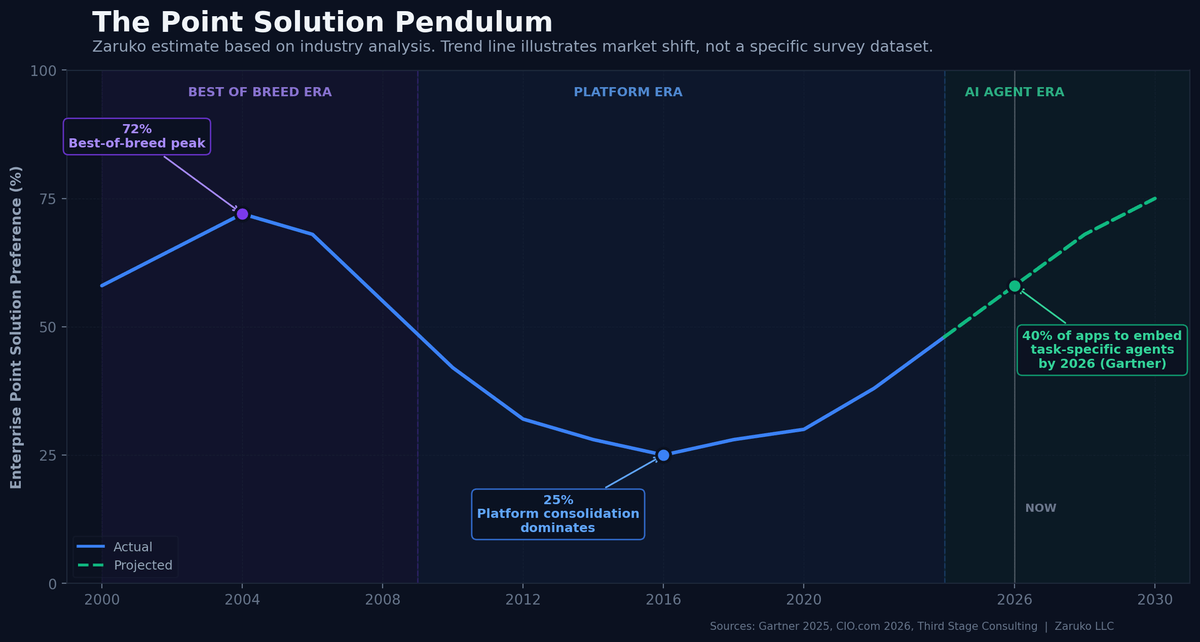
The point solution pendulum. The market swung from best-of-breed to platform consolidation. AI agents are swinging it back.
The numbers from MuleSoft's 2025 Connectivity Benchmark (surveying 1,050 IT leaders with Vanson Bourne and Deloitte Digital) show the scale of this problem in large enterprises today: the average enterprise runs 897 applications, and only 29% of them are connected. IT teams spend 39% of their time building custom integrations rather than working on new capabilities. Mid-market app counts are smaller, but integration bandwidth is much smaller too, so the pain is proportional. The 2026 report found that 86% of IT leaders say unintegrated agents add more complexity than they remove.2
What Changes with AI Agents
AI agents change this equation in two fundamental ways.
First, orchestration can now absorb the complexity cost that used to fall on IT teams. Orchestration is the control plane: it decides which agent runs, what data it can touch, how context is passed between agents, and what gets logged or escalated. Modern orchestration layers handle agent coordination programmatically. Which agent acts, when it acts, what context it receives, and how it passes results to the next agent in the chain can all be managed by the orchestration system rather than by your people. The old integration maintenance, data sync, and workflow routing problems do not disappear, but they shift from manual human work to automated system management.
Second, and this is the part most people are missing, AI agents can collaborate in ways that traditional point solutions never could.
Old point solutions could integrate. They could share data through APIs and connectors. But they could not work together on a problem. The difference matters.
What Agent Collaboration Actually Looks Like
Consider three scenarios that illustrate the difference between integration and collaboration.
Finance and Accounting. An accounts payable agent flags that a vendor's invoices have increased 23% over the past quarter with no corresponding change in purchase orders. It alerts a contract management agent, which checks the vendor agreement for price escalation clauses. Finding none, it passes the issue to a spend analytics agent that pulls comparable vendor pricing. Your CFO gets a briefing with the problem, the contract context, and market alternatives. No human chased any of that down.
Supply Chain and Logistics. A customer service agent detects a spike in complaints about late deliveries. It passes that pattern to a logistics agent, which traces the problem to a specific distribution center and flags it to a procurement agent that checks whether the carrier contract has an SLA violation. Three agents, three domains, one coordinated investigation that would have taken a cross-departmental team days of emails and meetings.
HR and Workforce Operations. A workforce planning agent notices that attrition in the engineering team has accelerated over three months. It shares that signal with a compensation benchmarking agent, which finds salaries have fallen below market in two key roles. A recruiting agent automatically adjusts job posting priority and salary ranges for open positions. The CHRO sees the trend, the root cause analysis, and the corrective action already in motion. In practice, most organizations would insert a human approval step before the salary adjustment goes live. The agents did the analysis and prepared the recommendation. The CHRO made the call. That is the right division of labor for a decision with budget and retention implications.
In each of these scenarios, the agents are not just sharing data. They are passing context, drawing conclusions, and taking coordinated action across functional boundaries. No single platform does all of these things at best-of-breed quality. But multiple focused agents, properly orchestrated, can deliver compound value that exceeds what any one system could produce alone. We dig deeper into the patterns and risks of multi-agent collaboration in a separate post.
The Market Is Splitting
What we are seeing now is a bifurcation in the market. Two legitimate models are emerging, and both have real trade-offs.
Full platforms with embedded agents. Salesforce Agentforce, ServiceNow, Microsoft Copilot Studio, and similar offerings are adding agent capabilities inside their existing ecosystems. The advantage is built-in orchestration and governance. The disadvantage is the same one platforms have always had: no platform is best-of-breed at everything, and you are locked into one vendor's vision of how agents should work.
Best-of-breed agents with external orchestration. Specialized vendors building the best possible agent for a specific domain, connected through orchestration layers and emerging protocols like Anthropic's Model Context Protocol (MCP) and Google's Agent-to-Agent Protocol (A2A). The advantage is superior performance in each domain and the flexibility to swap components. The disadvantage is that you own the orchestration, governance, and guardrails yourself.
The Deloitte data puts a number on this choice. Their projections suggest the autonomous AI agent market could reach $35 billion by 2030 under baseline assumptions. But if enterprises get orchestration right, that number could be 15 to 30% higher, potentially reaching $45 billion.3 That gap, roughly $10 billion, is the orchestration uplift. It is the additional market value that gets created when organizations figure out how to make multiple agents work together effectively.
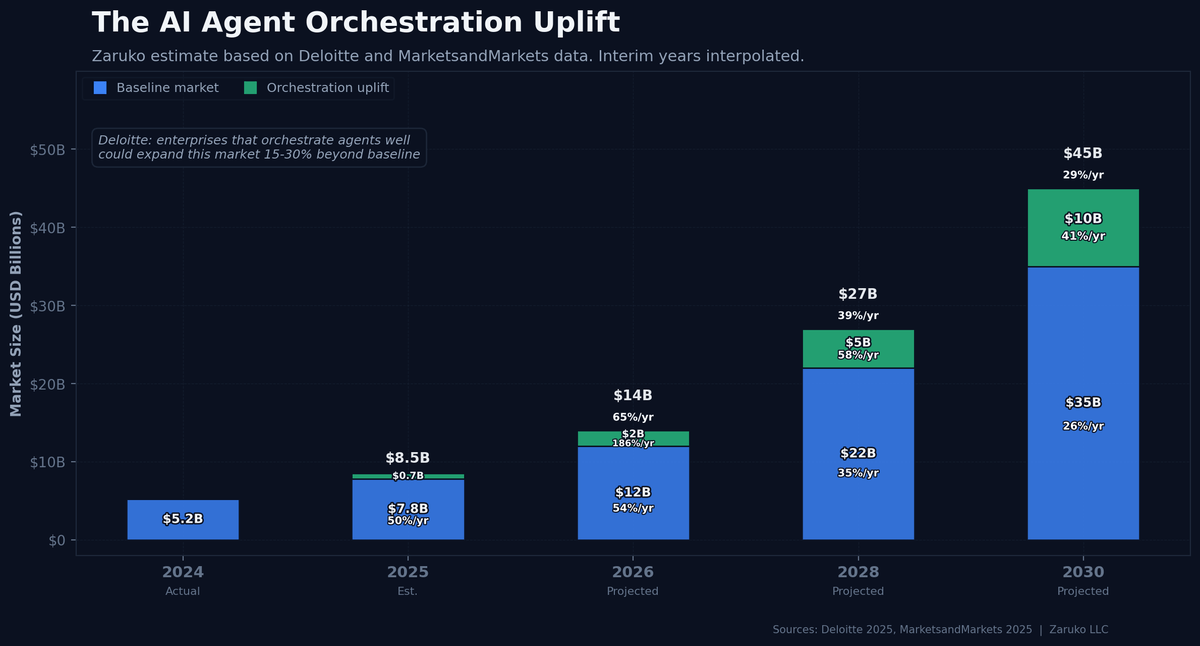
The orchestration uplift. Enterprises that get agent orchestration right could expand the market 15-30% beyond baseline projections.
Guardrails Become Infrastructure
Here is where the argument comes together.
When you run a single AI agent inside a single platform, guardrails are a feature. The platform handles permissions, logging, and escalation. It is someone else's problem.
When you run multiple agents from multiple vendors, orchestrated across your business, guardrails become infrastructure. They are no longer a feature of any single product. They are the connective tissue that makes the entire system safe and governable.
This means governance, permissions, audit trails, escalation paths, and kill switches need to exist at the orchestration layer, not at the individual agent level. The questions that matter are not "does this agent have guardrails?" but rather: Who decides which agent acts on what? What happens when two agents have conflicting instructions? Who is accountable when an autonomous agent makes a decision that affects another agent's domain? How do you audit a chain of actions that spans three agents and two vendors?
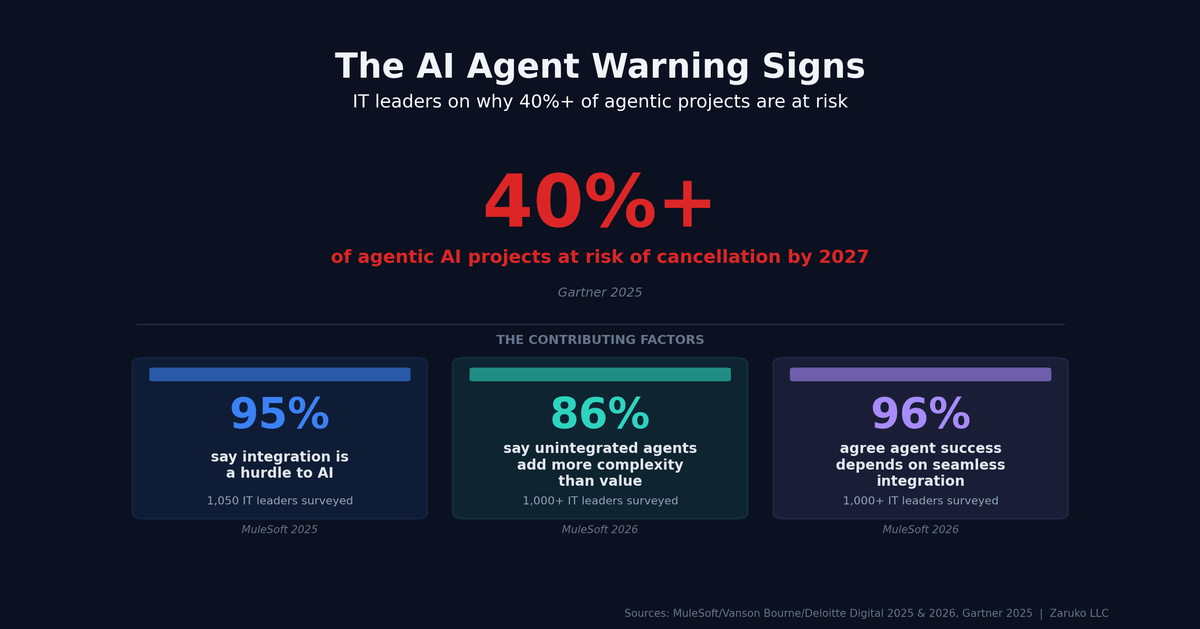
The warning signs. Without proper orchestration and governance, AI agents add complexity instead of removing it.
Gartner's projection that more than 40% of agentic AI projects could be canceled by 2027 is not about the agents themselves failing.4 It is about the orchestration, governance, and complexity management around them being inadequate. The agents work. The operating model around them does not. The technology is not the bottleneck. The organizational infrastructure to manage it is.
The Business Decision
For business leaders evaluating their approach to AI agents, the question is no longer whether to adopt them. It is how to structure the adoption.
If you are a mid-market company with limited IT capacity, starting with a platform that includes agent capabilities (Salesforce, ServiceNow, Microsoft) reduces your orchestration burden. You trade flexibility for simplicity.
If you are an organization with strong technical leadership and specific domain requirements, assembling best-of-breed agents with an orchestration layer gives you superior performance and flexibility. You trade simplicity for control.
Either path is viable. Neither is free. And in both cases, the organizations that invest in the governance and orchestration layer, not just the agents themselves, will capture disproportionate value.
The point solution pendulum is swinging back. But this time, the enterprises that succeed will not be the ones with the best individual tools. They will be the ones with the best system for making those tools work together.
Sources
- Gartner, "Gartner Predicts 40% of Enterprise Apps Will Feature Task-Specific AI Agents by 2026," August 2025. 40% of enterprise applications will include task-specific AI agents by end of 2026, up from less than 5% in 2025. gartner.com ↑
- MuleSoft, "2025 Connectivity Benchmark Report" (with Vanson Bourne and Deloitte Digital), January 2025; and "2026 Connectivity Benchmark Report," 2025. Average enterprise runs 897 applications with only 29% connected; IT teams spend 39% of time on custom integrations; 86% of IT leaders say unintegrated agents add more complexity than they remove. mulesoft.com ↑
- Deloitte, "Unlocking Exponential Value with AI Agent Orchestration," November 2025. Autonomous AI agent market could reach $35B by 2030, with enterprises that orchestrate effectively expanding that 15-30% to potentially $45B. deloitte.com ↑
- Gartner, "Gartner Predicts Over 40% of Agentic AI Projects Will Be Canceled by End of 2027," June 2025. Project failures attributed to inadequate orchestration, governance, and complexity management rather than agent capability. gartner.com ↑
Frequently Asked Questions
Are AI agents bringing back point solutions in enterprise software?
Yes. AI agents work best with narrow scope and clear boundaries, which makes them natural point solutions. Gartner predicts 40% of enterprise applications will include task-specific AI agents by 2026, up from less than 5% in 2025. The key difference from the last era of point solutions is that modern orchestration layers can absorb the complexity cost that previously made best-of-breed approaches too expensive to maintain.
What is AI agent orchestration and why does it matter?
Orchestration is the control plane that decides which agent runs, what data it can touch, how context passes between agents, and what gets logged or escalated. It shifts integration maintenance, data sync, and workflow routing from manual human work to automated system management. Deloitte estimates that enterprises getting orchestration right could expand the AI agent market 15-30% beyond baseline projections, a roughly $10 billion difference by 2030.
Should my company use AI platforms or best-of-breed AI agents?
Both paths are viable. Platforms with embedded agents (Salesforce, ServiceNow, Microsoft) reduce orchestration burden but lock you into one vendor's vision. Best-of-breed agents with external orchestration give superior domain performance and flexibility but require you to own the governance layer. Mid-market companies with limited IT capacity typically benefit from starting with a platform approach. Organizations with strong technical leadership and specific domain requirements may prefer best-of-breed.
Continue Reading
Where Your AI Agents Actually Run: Compute, Data, and Infrastructure Decisions
AI agents need compute, data access, and runtime environments. The infrastructure decisions you make now will shape cost, security, and vendor dependency for years.
The Orchestration Layer: What It Is, What It Does, and What to Look For
The five core functions every orchestration layer must perform, and what to look for when evaluating solutions.
The Unbundling of LLMs
LLM wrappers get dismissed. But the companies building real workflow around foundation models are following the same pattern that created billion-dollar SaaS companies.
Building your AI agent strategy?
I help mid-market companies navigate the platform vs. best-of-breed decision and build the orchestration layer that makes AI agents work together safely. Let's talk.
Let's Talk