74% Want Revenue from AI. 20% Are Getting It.

President, Zaruko
Table of Contents
Here's a number that should make every mid-market CEO stop and think: 74% of companies investing in AI have yet to demonstrate tangible value from their investment.
The money is spent. The pilots ran. The results aren't there. And the gap between the companies that are getting value and everyone else is getting wider, not narrower.
The Numbers
BCG surveyed hundreds of companies in 2024 and found that 74% struggle to achieve and scale value from AI.1 By September 2025, they updated the picture: 60% of companies are generating "hardly any material value" from AI investments. Only 5% are creating substantial value at scale.2
McKinsey's 2025 State of AI report tells a similar story from a different angle. 88% of companies use AI in at least one business function. But only 39% see an impact on EBIT, and most of those impacts are less than 5%. Over 80% of respondents reported no meaningful impact on enterprise-wide EBIT.3
Read that again. Nearly nine out of ten companies have adopted AI somewhere in their organization. Fewer than four out of ten can point to a financial result. And the results, when they exist, are small.
The adoption curve is ahead of the value curve, and the gap is growing.
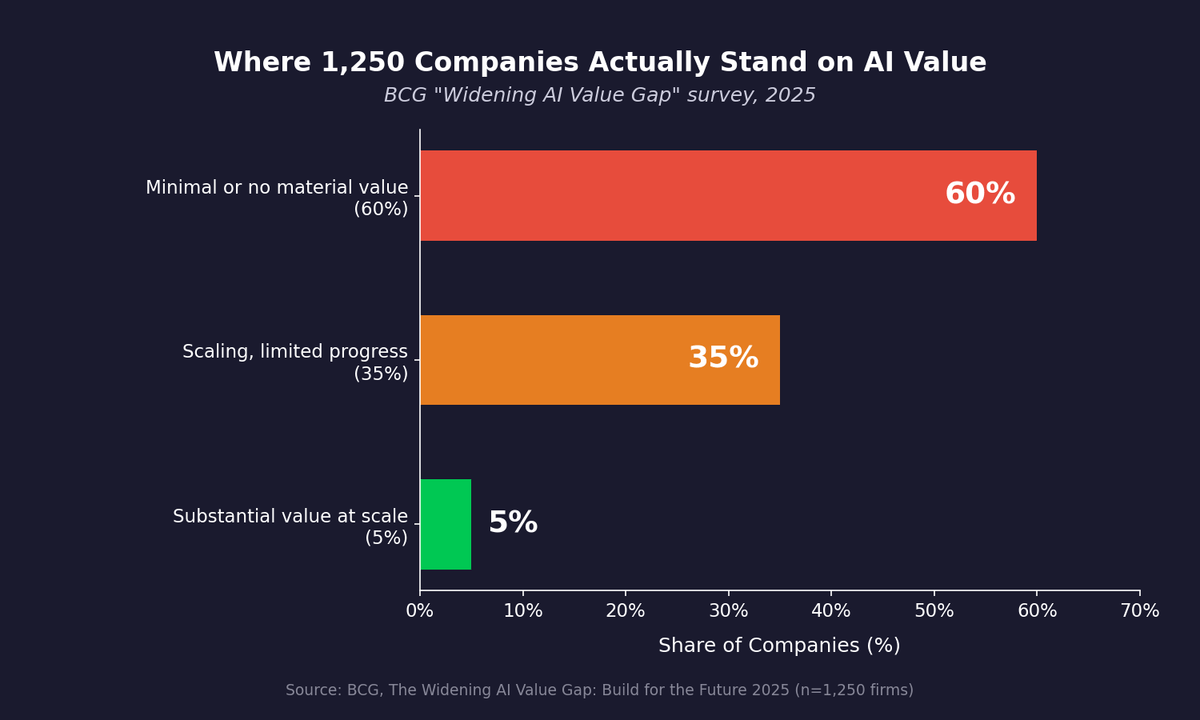
Where 1,250 Companies Actually Stand on AI Value: BCG's 2025 survey shows 60% generating minimal or no value, 35% scaling but limited, and just 5% achieving substantial returns.
Where the Money Goes Wrong
MIT's NANDA initiative found that generative AI budgets are heavily concentrated in sales and marketing tools, even as some of the clearest returns are showing up in back-office automation.4
The biggest actual ROI? Eliminating outsourced business processes. Cutting external agency costs. Reducing manual steps in operations.4
Companies are buying what sounds exciting. They are not buying what generates returns.
This is a pattern you see in every technology cycle. The most visible use cases attract the most investment. The most valuable use cases are boring, operational, and hard to put in a press release.
IDC projects global AI spending will reach $630 billion by 2028.5 RAND notes that by some estimates more than 80% of AI projects fail.6 At that rate, hundreds of billions in investment are at risk over the next three years.
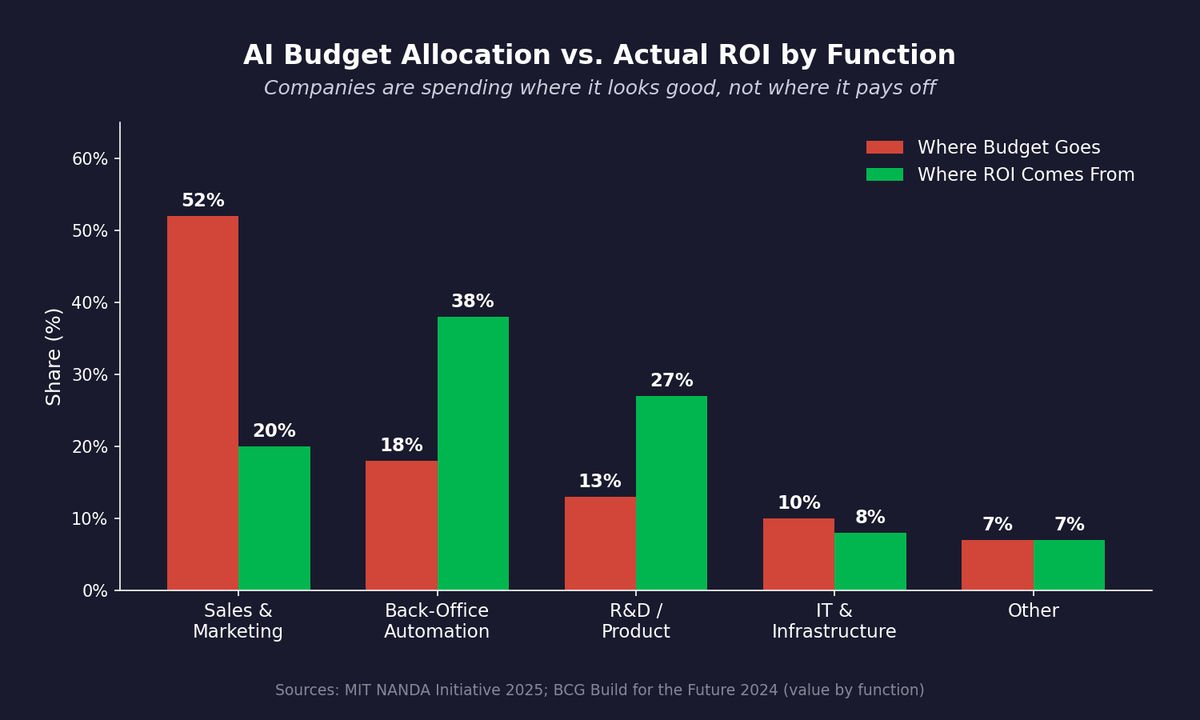
AI Budget Allocation vs. Actual ROI by Function: GenAI budgets are heavily concentrated in sales and marketing tools, while back-office automation and R&D deliver the highest share of actual returns.
Why the Winners Are Pulling Away
BCG's data shows something more concerning than aggregate failure rates. The companies that do succeed with AI are pulling ahead fast.
AI leaders achieve 1.7x higher revenue growth and 3.6x greater three-year total shareholder returns than their peers.2 These "future-built" companies plan to spend 64% more of their IT budget on AI than laggards.2
This creates a compounding problem. The winners reinvest AI-driven returns into stronger capabilities. The laggards fall further behind. BCG calls it the "widening AI value gap."
The difference between these groups is not better technology or bigger budgets. McKinsey found that organizations reporting significant financial returns are nearly three times as likely to have fundamentally redesigned workflows before selecting their modeling approach.3 They start with the business problem, not the technology.
Roughly one-third of organizations have begun scaling AI. Most remain stuck in experimentation or pilot phases.3
The Mid-Market Problem
If you run a $10 million to $100 million company, the implication is harsher than the aggregate numbers suggest.
Large enterprises can run 30 or 40 pilots, expect most to fail, and find winners through volume. Omdia's 2025 survey found that 43% of firms with under $100 million in revenue are running fewer than 5 AI proofs of concept.7 With fewer shots and fewer resources, each bet matters more.
Every dollar and every project has to count. That changes the math completely.
It means you cannot afford to follow the same playbook as a Fortune 500 company. You cannot run ten pilots and hope three work. You need to pick one or two bets, scope them tightly, attach them to a specific financial outcome, and measure ruthlessly.
The MIT study found that purchasing AI tools from specialized vendors succeeds about 67% of the time, while internal builds succeed only one-third as often.4 For mid-market companies with limited engineering resources, this is useful data. Buy before you build. Partner before you hire.
What a Realistic AI Investment Looks Like
Start with the workflow, not the technology. What process costs the most, has the most manual steps, and has the clearest success criteria? That is your first AI project. Not the most interesting problem. Not the one that impressed you in a demo. The one where the math works.
Budget for integration, not just licensing. The model is 20% of the cost. Data preparation, integration with existing systems, change management, and ongoing maintenance are the other 80%. If your budget only covers the license, you don't have a budget.
Set a 90-day kill switch. If the pilot isn't showing a measurable path to ROI by 90 days, stop. Redirect the resources. Don't let it become a zombie project generating optimistic status updates.
Measure in dollars, not demos. "It's faster" is not ROI. "It saved X hours at Y cost, net of the cost to build and run the system" is ROI. If you can't put a number on it, you don't know if it's working.
The 74% Are Not Failing Because AI Doesn't Work
They are failing because they are implementing AI like a technology project instead of a business transformation.
They buy tools before identifying the problem. They measure activity instead of outcomes. They polish pilots instead of redesigning workflows. They compare themselves to what AI companies promise instead of what their own P&L requires.
The companies that are succeeding figured out that AI is an operations problem, not a technology problem. The technology works. The question is whether your organization is built to use it.
That's not a technology question. It's a management question. And for mid-market companies, it's the most important question of the next two years.
Sources
- BCG, "AI Adoption in 2024: 74% of Companies Struggle to Achieve and Scale Value," October 2024. ↑
- BCG, "The Widening AI Value Gap," September 2025 (60% no material value; 5% substantial value at scale; future-built firms: 1.7x revenue growth, 3.6x three-year TSR, 64% more IT budget on AI). ↑
- McKinsey, "The State of AI in 2025" (88% adoption; 39% EBIT impact; 80%+ no meaningful enterprise EBIT impact; roughly one-third scaling; high performers nearly 3x as likely to redesign workflows). ↑
- MIT NANDA Initiative, "The GenAI Divide: State of AI in Business 2025" (GenAI budgets concentrated in sales/marketing; biggest ROI in back-office; vendor purchases: 67% success rate). ↑
- IDC, 2025 ($630B global AI spending projected by 2028). IDC ↑
- RAND Corporation, 2024 (notes that by some estimates more than 80% of AI projects fail). RAND ↑
- Omdia AI Market Maturity Survey, 2025 (43% of sub-$100M firms running fewer than 5 POCs). Omdia ↑
Frequently Asked Questions
Why are most companies failing to get ROI from AI?
BCG found that 74% of companies struggle to achieve and scale value from AI, and 60% are generating hardly any material value. The problem is not the technology. It is implementation. Companies buy tools before identifying the business problem, measure activity instead of outcomes, and polish pilots instead of redesigning workflows. McKinsey found that organizations reporting significant financial returns are nearly three times as likely to have redesigned workflows before selecting their modeling approach.
How should mid-market companies invest in AI differently than large enterprises?
Large enterprises can run 30-40 pilots and find winners through volume. Mid-market companies ($10M-$100M revenue) cannot afford that approach. 43% of firms under $100M are running fewer than 5 AI proofs of concept. Each bet matters more. Pick one or two projects, scope them tightly to a specific financial outcome, and measure ruthlessly. MIT research found that buying AI from specialized vendors succeeds about 67% of the time, while internal builds succeed only one-third as often.
What percentage of companies are getting real value from AI?
Only about 5% of companies are creating substantial value from AI at scale, according to BCG's 2025 survey of 1,250 firms. About 35% are scaling but with limited results, and 60% are generating minimal or no material value. The companies that do succeed achieve 1.7x higher revenue growth and 3.6x greater shareholder returns than their peers, and they reinvest those returns, widening the gap further.
Continue Reading
Your AI Pilot Worked. That's the Worst Thing That Could Have Happened.
88% of AI proofs-of-concept never reach production. The problem isn't the technology.
Before You Bet 90 Days on AI: An Operator's Scoping Checklist
Most AI projects fail because they're scoped like technology rollouts, not process experiments.
PE's Zombie Problem Isn't About Capital. It's About Operations.
Same investment-without-result pattern playing out in private equity. Operations is where the gap closes.
Getting real returns from AI, not just pilots?
I help mid-market companies close the gap between AI spending and financial results. Let's talk about where the math actually works for your business.
Let's Talk